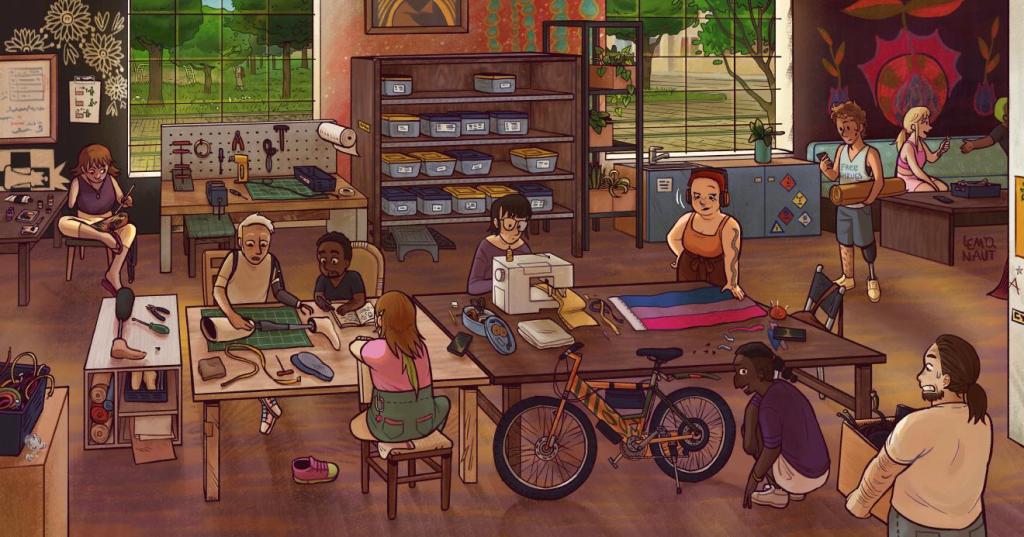
Autonomy & agency. People with disabilities are able to create individualized plans for the life they want to live, and can get the support they need to overcome any remaining barriers, while we work to dismantle those barriers on a societal level. People with disabilities experience strong community bonds and a sense of belonging in their neighbourhoods.
Education supports. Students with disabilities, including physical, cognitive, and learning disabilities are supported in the school system with adequate staff and funding. Across Ontario, the K-12 Education Accessibility Standard has been fully implemented, including oversight and guidance regarding isolation and sensory rooms in schools.
Public space retrofits. AODA policies have been fully implemented. Zero-interest loans are available to small businesses and property owners to make their buildings accessible, with mandatory compliance by 2030. Low sensory public spaces with rest areas are common throughout downtown. Hostile architecture that prevents people from sitting and resting in public spaces has been removed. All public spaces disclose their accessible design “report card” in a standardized way (i.e. stairs, power doors, washrooms).
Inclusive programming. Recreational activities include those with disabilities by default. Accessibility that considers physical and cognitive needs is normalized in public programming. Equity, diversity, and inclusion practices ensure equitable service access. Participation of neighbours with disabilities is commonplace, and they feel welcomed in all aspects of public life.
A day in the life: inclusion and community
Kali moves into her neighbourhood and her neighbours start popping by to introduce themselves and welcome Kali and her family to the area. Kali instantly feels seen and supported. She registers her children for school and is thrilled that there is no longer a lottery system for enrollment in French Immersion programming — anyone who wants it can have it! Kali’s son, who has a disability, receives the personalized support he needs to thrive at school and feels welcome in the local restaurants, cafes, parks, and libraries — he doesn’t have to find segregated places for connection and community. Both of Kali’s children travel to school on foot with other kids in their neighbourhood and parents take turns carpooling when there’s inclement weather or late-night extracurricular activities or school events.
A day in the life: inclusion and community
— Reflection by a roundtable participant
Kali moves into her neighbourhood and her neighbours start popping by to introduce themselves and welcome Kali and her family to the area. Kali instantly feels seen and supported. She registers her children for school and is thrilled that there is no longer a lottery system for enrollment in French Immersion programming — anyone who wants it can have it! Kali’s son, who has a disability, receives the personalized support he needs to thrive at school and feels welcome in the local restaurants, cafes, parks, and libraries — he doesn’t have to find segregated places for connection and community. Both of Kali’s children travel to school on foot with other kids in their neighbourhood and parents take turns carpooling when there’s inclement weather or late-night extracurricular activities or school events.
Access and safety. Buildings, transportation services, public spaces and healthcare are more accessible to people with disabilities of all types, including physical, cognitive, and behavioural needs, who can independently choose how to engage with their community. These improvements to access and safety have co-benefits for other neighbours including youth, caregivers, and elderly residents.
Livable social assistance. We have increased ODSP and OW rates to meet the cost of living, with increases tied to inflation. The ODSP housing allowance has been increased to match the average market rent in the specific neighbourhood where somebody lives. We recognize that cost of living has various factors and can change depending on the city and depending on the neighbourhood, and assistance programs have changed to reflect that. Rates of medical assistance in dying (MAID) due to poverty have fallen to zero, as people have adequate financial and social support. MAID is used in a more limited way, eliminating poverty as a defensible rationale, bringing Canada in line with other countries.
Emergency preparedness. Neighbours with disabilities are included in emergency preparedness planning, and we have planned for accessible evacuation routes and communication tools in the case of an emergency.
Healthcare accessibility. We have overcome the barriers faced by neighbours with disabilities in hospital and healthcare settings, including coordination of care transitions and accessibility accommodations; communication supports; adequate education and training for healthcare providers; and ensuring that equipment is accessible.
Disability justice: measurable outcomes
- Proportion of fully accessible public spaces (indoor and outdoor)
- Diversity of participants, creators, and collections in arts and culture institutions
- Proportion of transit stops with curb cuts, shelters, and non-visual schedule information (by neighbourhood)
- Representation of people with disabilities in policy decisions and implementation
- Number of public events with sign language interpreters and live captions
- Time spent on waitlist for accessible public housing
- Proximity of accessible housing to transit, healthcare, and essential services
- Use of universal design principles in new public buildings and spaces
- Budget allocation for implementation of accessibility improvements
- Ratio of ODSP shelter allowance compared to median market rent
- Rates of medical assistance in dying (MAID) due to poverty
 One Million Neighbours Waterloo Region