Happy New Year! We hope that you were able to rest and recharge over the holidays. The days are (slowly) getting longer, and we are full of gratitude for all the collaborations and partnerships that continue to unfold throughout the Region.
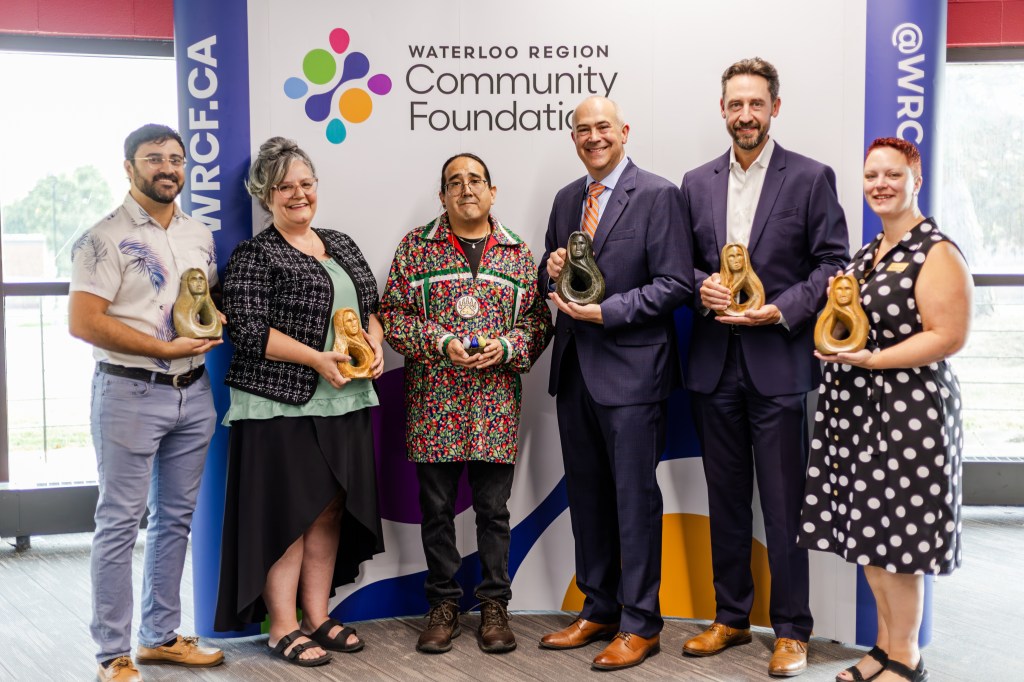
Since we last sent an update, Sam Nabi was awarded the Social Infrastructure Champion Award from the Waterloo Region Community Foundation. This award recognized his community organizing work, including his role as Project Coordinator for One Million Neighbours. The award celebrates innovation, excellence, and ongoing commitment to advancing social infrastructure in Waterloo Region.
We want to thank all of the grassroots groups and non-profits who have participated in the One Million Neighbours roundtables, all the people who we’ve spoken with at community events, and the volunteers who have helped with policy research, data analysis, and storytelling support. We’re building an important voice advocating for resilient, inclusive, and abundant neighbourhoods as our region grows.
The Neighbourhood Services Map is here
We’re really excited about this one — a concept sparked by one of our roundtable conversations in Cambridge has been nurtured from an idea to a real tool, and we just launched it today!

The map reveals how access to various services differs between neighbourhoods across Waterloo Region. As we grow to 1,000,000 people in the coming decades, we need to know that we are allocating resources equitably and that we are building a region where people in every neighbourhood can thrive.
Each neighbourhood has been ranked as “most access”, “average access”, or “least access” based on these factors:
- Transit
- Green Space
- Schools
- Healthcare
- Libraries
- Community Spaces
The map also accounts for population, so a neighbourhood that has grown rapidly without a corresponding investment in services will see its ranking decline.
The map can tell us some surprising facts about our region — while generally, Kitchener and Waterloo are better-served than Cambridge, there are pockets in all three cities ranked “least access” for different reasons.
Rural neighbourhoods fare very well in the overall ranking, due to their abundance of green space, community spaces, and even libraries relative to their population. However, they have low access to healthcare and transit services.
Some neighbourhoods that are considered major transit destinations, such as the university district and uptown Waterloo, are only ranked “average” when it comes to transit. This is because the massive population growth in those neighbourhoods warrants even more transit service than they currently have.
The project was developed in collaboration with Civic Tech WR, a volunteer group of software and data professionals who build tech solutions for civic change.
Congratulations to Familles Afro FrancoFun!
One Million Neighbours worked with Cathy Kenne, Executive Director of Cambridge-based Familles Afro FrancoFun, to secure her organization’s first-ever grant!
We provided administrative and translation support in a pitch competition for the KW Awesome Foundation, helping to secure $1000 for culturally-appropriate public speaking workshops in French for newcomer youth.
This program is essential for helping youth gain confidence and communication skills, while keeping a strong connection to their cultural heritage in a majority-anglophone community.
To learn more, connect with Familles Afro FrancoFun on Facebook: https://www.facebook.com/profile.php?id=61570626463265
 One Million Neighbours Waterloo Region